In gamification, it is very important to know who you are dealing with, so that it is possible to build a scenario that captivates and motivates the target audience. However, it is not easy to generalize people’s characteristics and preferences. Several studies have been conducted to overcome this challenge, and one of the results found were the Player Types.
Richard Bartle, writer and professor at the University of Essex, conducted a study on game development and design, as well as the personality of MMO (Massive Multiplayer Online) game players.
Based on gameplay preferences, he classified players into 4 types.
Bartle’s 4 Player Types
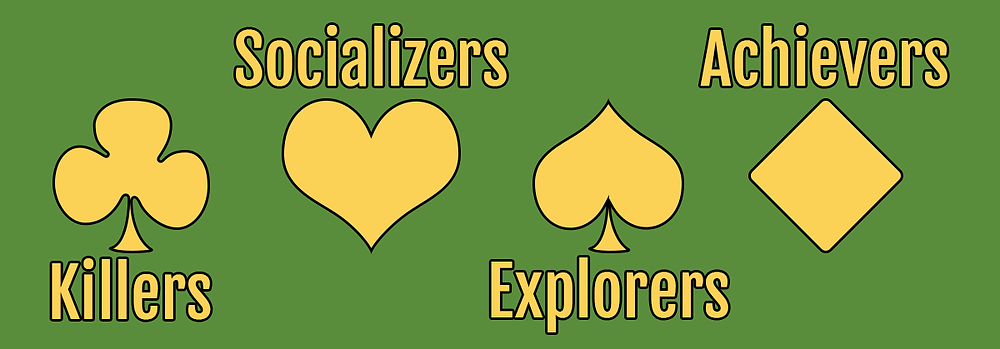
Killers, Socializers, Explorers, and Achievers. These were the 4 main player types that Bartle identified in his research, and they can be defined as follows:
Killers
These players live for the competitive elements of the game. They are called “Clubs” because they like to “bring the competition.” They love the opportunity to compete (and win) against other players. It does not matter if they are toxic or if they break the rules – for them, the goal is to be the winner.
Socializers
These are individuals attracted to the social aspects of a game, rather than the strategy itself. They are the “Hearts” of the gaming world, because they have more fun interacting with other players. For them, it serves as a social vehicle that allows them to engage with others and build interesting relationships.
Explorers
Players who seek the thrill of discovery, learning about something new or unknown. Referred to as “Spades,” because they tend to dig and uncover things, explorers feel a rush of excitement when they discover a rare artifact or a secret path.
Achievers
Players who focus on attaining some level of success, measured by points, prizes, material goods, or other evaluation criteria. Known as “Diamonds,” they strive to earn rewards, recognition, and prestige.
Bartle’s Player Types are defined through 30 random questions that identify characteristics associated with the defined players. The Bartle Test can be taken online at the provided link, so you can find out which Player you are according to this theory.
However, this research was focused on the multi-user dungeons universe, or “MUDS” games, which made the classification limited for external environments and other types of games.
Looking from Another Angle, More Focused on Gamification
Andrzej Marczewski begins his research a few steps behind the studied concept and initially defines his players as those who are willing to play and those who are not.
The difference between these two players is the form of motivation that best influences each one. Those willing to play are extrinsically motivated, while those not willing are intrinsically motivated.
To better understand the types of motivation, read our text “How can gamification make learning more effective?” where we discuss this in more detail.
And as a result of his studies, Andrzej arrived at the HEXAD Framework which divides players into 6 types: Players, Achievers, Socialisers, Free Spirits, Philanthropists, and Disruptors.
The HEXAD Framework
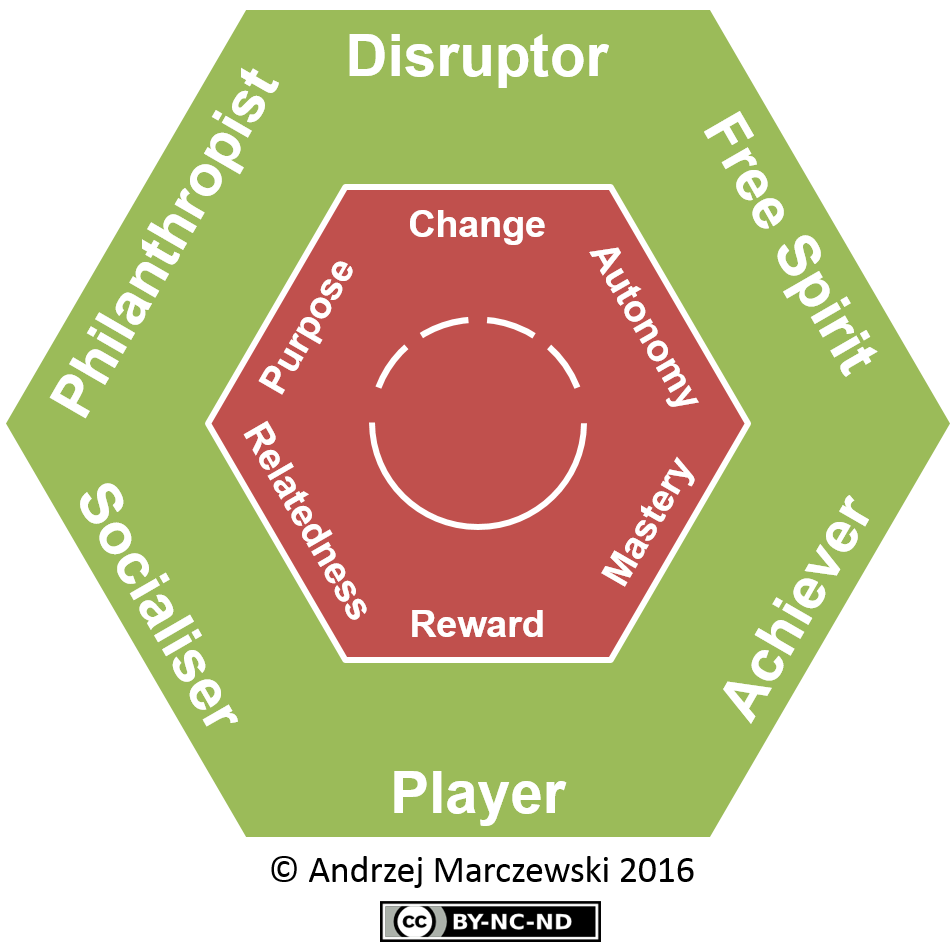
The HEXAD is represented by the hexagon shown, as the name suggests. In it, you can see the 6 player types and the main motivation of each one.
The 4 intrinsically motivated players follow the RAMP Theory (Self-Determination Theory RAMP) and their motivations follow this relationship:
- Achiever - Mastery
- Socialiser - Relatedness
- Free Spirit - Autonomy
- Philanthropist - Purpose
The other 2 types, extrinsically motivated, are driven by rewards (Player) and by the desire to change the system (Disruptor).
The 6 can be explained as follows:
Players
They do everything to gain something from the system, regardless of the type of activity. They enjoy achieving conquests and having their names on the leaderboard.
Achievers
They seek to progress within a system by completing tasks or proving themselves by facing difficult challenges. They want to be the best in terms of internal knowledge of the system; however, without worrying about showing it to everyone (which differentiates them from Bartle’s conception of Achiever).
Socialisers
They want to interact with others and create social connections. They are interested in the parts of the system that allow them to do so, and they promote and publicize internal events within the environment.
Free Spirits
They enjoy creating and exploring the system in which they are immersed – in other words, they want to have freedom to express themselves and act, without external control. They do not want to be restricted in how they live their personal journeys.
Philanthropists
They are altruistic and eager to help, without expecting a reward. They feel that they are part of something bigger and want to give back. They dedicate themselves to the “cause” because they enjoy contributing.
Disruptors
They are motivated by triggering change. They tend to disturb the system directly or through others to force negative or positive changes. They like to test the limits of the system and try to go beyond.
You must be imagining how difficult it is to create a gamified system that reaches all player types, given that they are so different, and indeed it is very difficult. However, by analyzing the target audience, it is possible to focus the gamification on a main player type and complement it with techniques that satisfy the other types.
Just like Bartle’s research, it is also possible to take a test to see your Player definition according to the HEXAD, which helps greatly in the analysis for the system. Andrzej’s Test can be taken at the provided link.
A Vision Beyond
And the player types do not end with the research cited so far. Although the HEXAD is one of the main (if not the main) frameworks used for this, Andrzej Marczewski went further, joined forces with Bartle, and expanded his research.
With the new perspective and following Bartle’s suggestions, Andrzej was able to illustrate a relationship pattern among the player types not willing to play, which were now the focus of the studies.
However, not all users fit into the 4 intrinsically motivated types. The Player-type player, despite seeing motivations in internal values, performs better due to external rewards.
To create a more complete vision, 4 new player types were created from the combination of the unwilling players and the possible extrinsic “rewards” they could receive. Networkers, Exploiters, Consumers, and Self Seekers.
This is how the 8 new player types emerged.
The 8 New Types
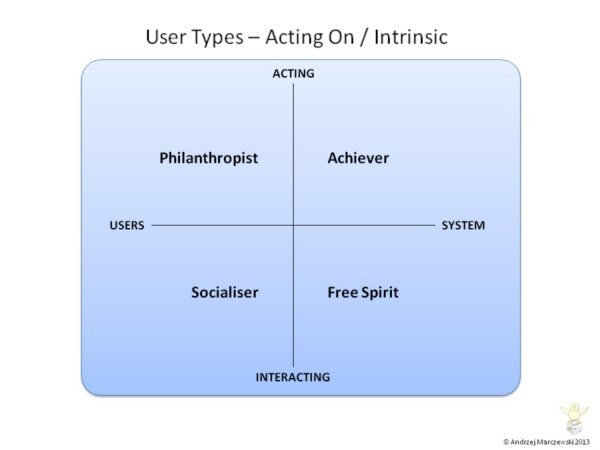
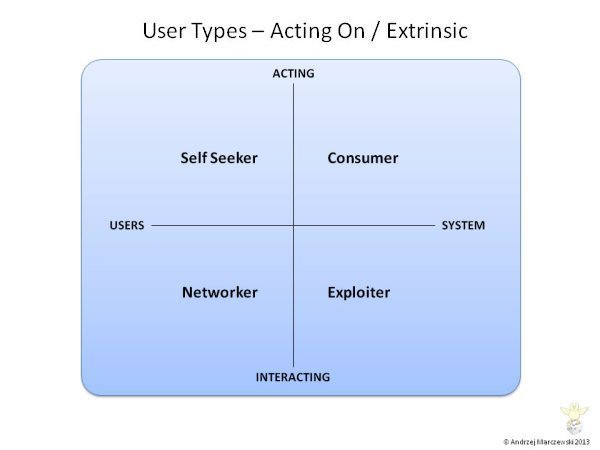
For a better visualization of the profiles created in his research, Andrzej divided them into 2 groups: those with an intrinsic base and those with an extrinsic base, resulting in 2 diagrams based on how they interacted with the system and with other users.
Intrinsic Base
- Philanthropists act upon users for intrinsic reasons
- For example, people who answer questions in forums or edit texts on Wikipedia.
- Achievers act on the system for intrinsic reasons
- People who learn from the system simply because they enjoy it. Those who wish to perfect a task simply because they want to. They can also be motivated by status as a representation of their personal achievements.
- Socialisers interact with users for intrinsic reasons
- People who enjoy talking with others and like being connected.
- Free Spirits interact with the system for intrinsic reasons
- Those who wish to enjoy the self-expression that a system can offer. They can also be explorers. They want to get the most out of a system because they have fun doing so.
Extrinsic Base
- Self Seekers act upon users to obtain extrinsic rewards
- They will answer questions and help other people, but only to get rewards and visible status from the system. Quantity over quality – unless quality earns more rewards. They are not interested in the social aspect of users.
- Consumers act on the system for extrinsic rewards
- A consumer wants to use a system that can give them something. An example would be people who use a specific airline because of the loyalty scheme.
- Networkers interact with users to obtain extrinsic rewards
- They want social connections, but to give them some kind of status or reward. An example of this is people who connect and tweet etc. just to get higher Klout scores.
- Exploiters interact with the system for extrinsic rewards
- Similar in nature to Self Seekers, these are the people who will like, vote, or retweet something multiple times to earn a reward. Unlike Free Spirits, who will push the limits of a system’s features for fun, they will likely find the loopholes in its rules to exploit them.
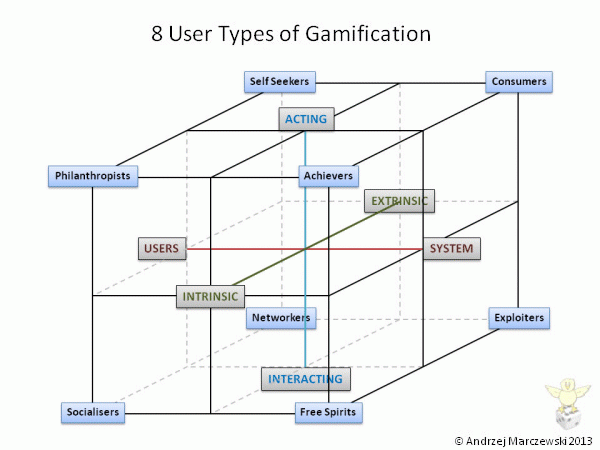
Andrzej also created a 3D diagram representing all 8 types. Note that it is formed by joining the two diagrams presented above with the addition of a Z axis that represents extrinsic and intrinsic motivations.
It is worth noting that when creating a gamified system, it is important to balance the player types it will receive. A system with too many extrinsically motivated players tends to fail, as users will consume a lot and contribute little.
Therefore, despite all the research on the 8 types, the best approach is to base your gamification on the 4 intrinsic types and build it around them. Then, once it is complete, add extrinsic rewards to appeal to the entire target audience.
To learn more about gamification and its benefits, feel free to read our post “What is gamification and how can it change your life,” browse the blog, follow us on social media (LinkedIn, Instagram, and Facebook), listen to our podcast, or get in touch with us! Our portfolio is open in case you want to see practical examples of this incredible Framework.
This post was originally written in Portuguese and translated to English by Claude (Anthropic).
Originally published on the Orc’estra Gamificacao blog. All rights reserved.