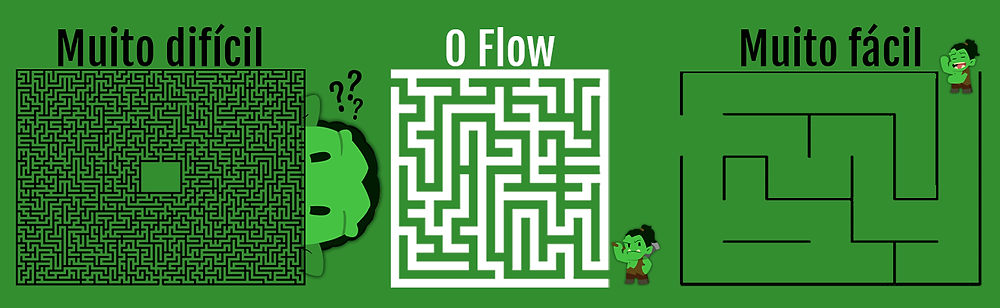
You know when a game is so difficult that you lose the will to play because you can’t make any progress? Or even when it’s so easy that there’s no fun in clearing a level? That happens because they deviate from Flow Theory, and this doesn’t apply only to games, but to everything you do throughout your life!
Flow Theory
Flow Theory was created and developed by Mihaly Csikszentmihalyi, a psychologist with a doctorate from the University of Chicago, but what does this theory consist of? Well, it was created with the purpose of explaining what makes a person feel happy and motivated in their everyday life.
Flow would be a mental state of happiness, satisfaction, and involvement while performing an activity.
For example:
- When you are reading a book and you are so immersed in the story and focused on it that you forget about your problems;
- Or when you are playing a game and you lose track of time, and before you know it, hours have passed;
- Or even when you are practicing a sport and you feel a serenity in doing it and in growing beyond the limits of the ego.
All of this falls within the characteristics of this state. In this way, the theory broadly addresses satisfaction and the principles of what makes life worth living.
However, how can we reach the flow state? How can we know if something we are doing will generate this engagement? These questions do not have a well-defined answer, because people feel pleasure and happiness in different activities.
Not everyone likes a particular book, or enjoys video games, or a specific sport. The happiness in doing something is related to external and internal factors, meaning it depends on your extrinsic and intrinsic motivations.
Nevertheless, in the research conducted by Mihaly, some elements were discovered that help identify the period of the “optimal experience”.
The main elements that contribute to this are the combination of challenge and skill, because when something is too challenging, the person tends to become frustrated while doing it, or when something is too easy relative to the person’s skill, they tend to feel bored. Flow would be the middle ground, the balance.
It would be a zone where something challenges you and you feel that you can do it, improve, and grow. You feel excited when facing that challenge.
Flow Theory and Gamification
And what is the relationship between Gamification and Flow Theory? For those who don’t know, gamification is the application of game techniques in non-game contexts with the purpose of motivating people, improving learning, productivity, solving problems, or changing behaviors in an environment.
We explain this in more detail in this blog post, so stop by later to better understand this concept.
A playful environment can be a way to reach the flow state, because among the properties used to gamify this environment is the study of how challenges will be presented according to the abilities of the analyzed “players.”
For example, in gamification we have a type of player called Achiever, whose motivation comes from accomplishing goals and achievements, so to satisfy this user, properties such as engagement curve and challenges are used, but beyond that, anticipation, community, curiosity, wonder, fun, and opportunities are also used to further increase motivation.
All of this contributes to achieving characteristics of the Flow State, such as focus, concentration, loss of the sense of time, ecstasy, and many others.
In this way, we notice that the relationship between Flow and gamification is linked to the use of psychological and social studies to generate engagement and motivation, in order to provide a better development flow in people’s activities.
Thus, when a gamified activity is applied correctly, it has the potential to successfully reach the flow state.
Author: Joao Vitor Alves. Co-authors: Samuel Avila and Iuri Severo.
This post was originally written in Portuguese and translated to English by Claude (Anthropic).
Originally published on the Orc’estra Gamificacao blog. All rights reserved.