Creating a new product, managing and developing projects… What do these activities have in common? They are hard to accomplish. Fortunately, there are some tools that can help with these activities, and Scrum is one of them.
What is Scrum?
The first sentence you will come across when looking for the definition of Scrum on its official website is “A better way to build products”.
Another common point in the definitions found on the internet is the fact that Scrum is a set of agile techniques used in the management and execution of projects. In other words, a development framework.
With a name derived from the sport of Rugby and with its initial use in the software field, this technique has now spread to other areas and has proven to be very effective in many other project contexts. Because of this, companies like Google and the British Broadcasting Corp (BBC) use it.
— Jeff Sutherland - Co-creator of Scrum and author of the book Scrum: The Art of Doing Twice the Work in Half the Time
But how does Scrum work?
Scrum consists of a Scrum Team and its roles, events, artifacts, rules, and principles that bind them together, as defined in the Scrum GuideTM. With this, it encourages teams to learn from experiences, organize themselves to solve a problem, and reflect on their achievements and failures to constantly improve.
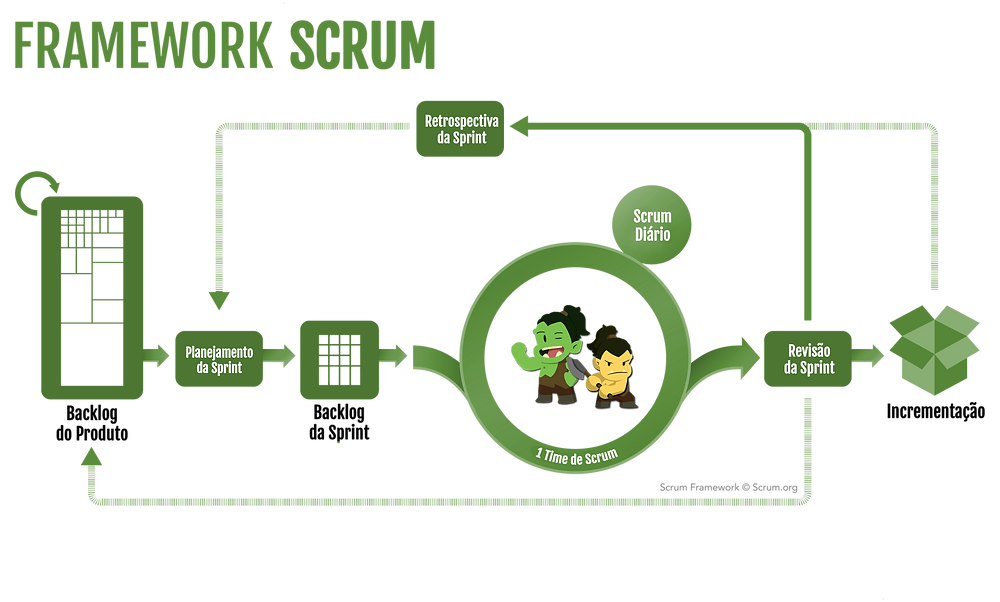
And don’t worry, I will explain what a Scrum Team is and all the other terms that come up. All definitions will be taken from the Scrum Glossary and translated in the best way possible so they are easy to understand.
The Scrum Team and Its Roles
The Scrum Team is a self-organizing team composed of a Product Owner, a Development Team, and a Scrum Master.
Product Owner: Responsible for maximizing the value of the product, primarily through managing and incrementally expressing the business expectations and product features to the Development Team. They are the bridge between client and developer.
Development Team: Responsible for managing, organizing, and executing all the development work needed to create a product increment each Sprint. More informally, they are the project’s “workforce.”
Scrum Master: Responsible for guiding, coaching, teaching, and assisting a Scrum Team in properly understanding and using Scrum. The person who makes the team follow the rules so that events and artifacts occur correctly.
But what are these events and what is this Sprint?
Sprints are Scrum events with a time frame of one month or less, which serve as time boundaries for the occurrence of other events and activities. Sprints are done consecutively, without intermediate breaks.
During a Sprint, the following events take place:
Sprint Planning: The moment when the Scrum Team inspects the Product Backlog to select the highest-value activities and project them into the Sprint Backlog, defining what will be done by the Development Team. It usually takes place 8 hours before the start of the sprint.
Sprint Retrospective: The moment when the Scrum Team inspects the past sprint and plans improvements to be made during the next sprint. It usually takes place 3 hours before the sprint is finalized.
Sprint Review: The moment when the Scrum Team and interested clients (stakeholders) inspect the product increment resulting from the sprint, evaluate the impact of the work done on overall progress, and update the Product Backlog to maximize the value of the project in the next period.
Daily Scrum: Commonly called the Daily, it is a moment that lasts about 15 minutes and serves for the Development Team to plan what will be done in the next 24 hours. This optimizes team collaboration and performance, as they begin to inspect and forecast the work being done.
The Daily takes place every day, throughout the Sprint.
Scrum Artifacts and Some Metrics…
During the events, I mentioned some terms, such as the Product Backlog and Sprint Backlog, and these are some of the Scrum artifacts. Along with them, there are also some metrics worth mentioning, such as Burn-Down and Velocity.
Product Backlog: Consists of an ordered list of work to be done to create, maintain, and sustain a product. It is usually managed by the Product Owner.
Sprint Backlog: Provides an overview of the development work to achieve the goal of a Sprint. It generally consists of a list with the forecast of features and the work needed to deliver those features. It is usually managed by the Development Team.
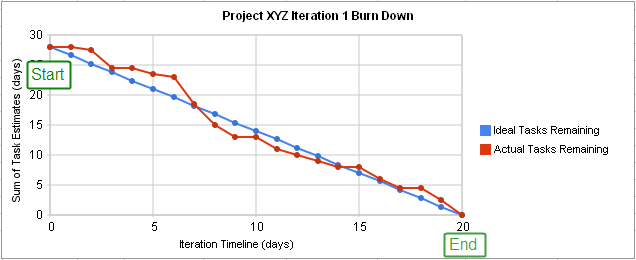
Burn-Down Chart: A chart that shows the estimated number of tasks for the sprint compared to its time period. According to the progress of time and completed tasks, a line is drawn, marking the tasks that have not yet been completed.
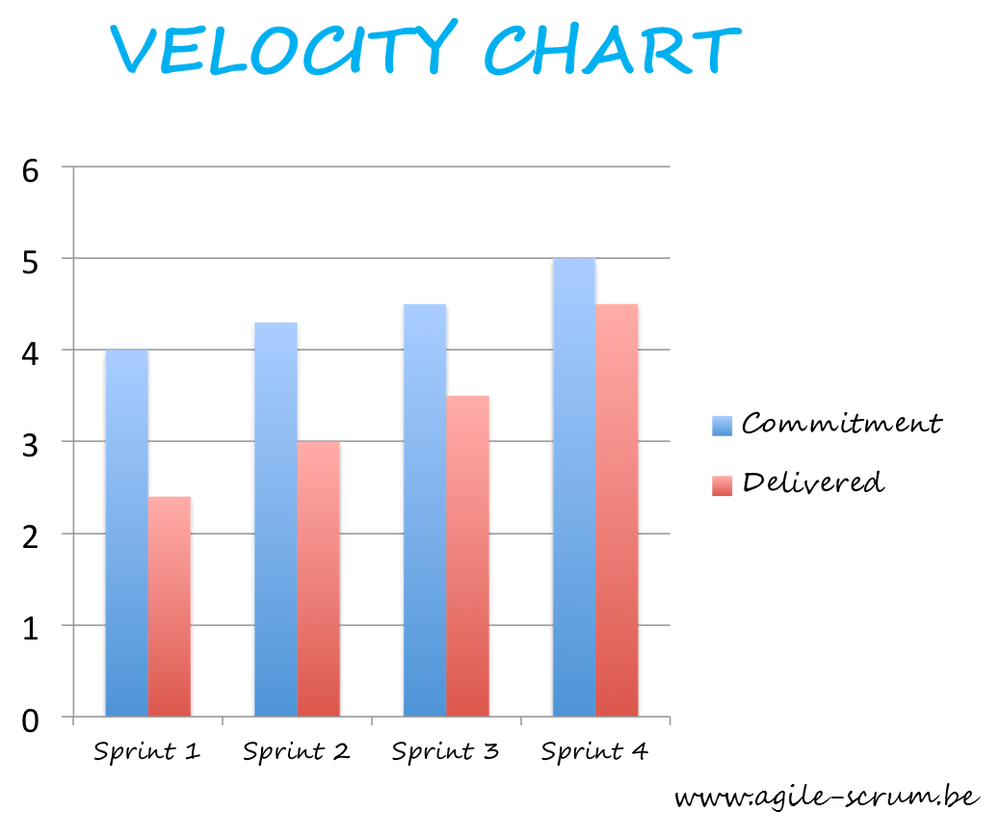
Velocity: An optional but widely used metric that indicates the number of tasks completed by the Development Team in a sprint relative to the expected number of tasks that would be completed.
Agile Principles
Furthermore, as mentioned, Scrum is a set of agile practices and principles that contribute to project development, and some of them are:
- Knowledge Management, so that everyone leaves the project with a similar learning foundation;
- Pair work on tasks, which contributes to their completion and improves knowledge management;
- Proximity to the Client, so that each stage of the project is validated and to achieve a more complete delivery, according to what the client truly wants;
- Adaptation, so that the project shapes itself according to needs;
- Transparency, to avoid errors and unpleasant surprises for the client.
So far I have shown you a lot about Scrum, but you must be wondering if this framework is really worth it, if it truly works! And, in case my words are not enough for you, I have also brought some examples of large companies (besides us) that use Scrum and other Agile practices.
3 Companies That Use Scrum and Other Agile Practices
At Google, agile development methodologies are used in various sectors and are defined according to the team and the technologies used in the project.
In the video “Scrum Tuning: Lessons learned from Scrum implementation at Google” you can watch a talk given by Jeff Sutherland, in which he discusses how Scrum was implemented at the company and gives examples of how the Adwords tool was developed using this framework.
British Broadcasting Corp.
Andrew Scotland, Head of Development at the BBC’s New Media Division, spoke at the JAOO conference about how Scrum transformed the projects carried out in the area.
Characterized by many uncertainties, creative chaos, no clear delivery model, and a demotivated and disenfranchised technical team with many unfinished software projects, the New Media Division became known for its delivery capability, with a team of hundreds of people who deliver iteratively and have Scrum integrated into the business.
— Andrew Scotland, Head of Development at the BBC's New Media Division
At Facebook, Scrum is not used; however, they use agile principles for better project management, communication between teams, and, of course, the final result.
When a new project is established at the company, they form a team of 6 or 7 people who will be responsible for it. This team is gathered in a room where they will work exclusively on what has been determined. In this room, they have all the necessary materials and each person works on the part of the project in which they are specialists.
By being gathered together, communication among members is increased, which intensifies knowledge management and enables each person to identify the specific problems in their area and solve them in the best way possible.
Direct communication, instead of coordination through emails, chats, or weekly meetings for task division (with no subsequent contact), allows solutions to be found more quickly.
But how can you apply Scrum in your company?
Now that you already know all this about Scrum, you must be asking yourself “How do I put this incredible framework into practice?”, after all, knowing the theory and applying it in practice are different things. But don’t worry, I have the answer for you!
The Gamified Scrum Training offers everything you need to know to start good project management and execution using this framework. It is worth noting that the training does not cover everything there is about Scrum (and there is a lot), but participants learn about the different roles, rituals, artifacts, and metrics of Scrum in theory and practice!
You can find more details about this service on the Training page of our website, as well as check out other work done by the company in our portfolio.
To learn more about gamification and its benefits, feel free to read our post “What is gamification and how it can change your life”, browse the blog, follow us on social media (LinkedIn, Instagram, and Facebook), listen to our podcast, or get in touch with us!
This post was originally written in Portuguese and translated to English by Claude (Anthropic).
Originally published on the Orc’estra Gamificacao blog. All rights reserved.