You have probably wondered what motivation is, where it comes from, and how it works. It really is something quite curious, about which little is known and which, according to psychology, is a key element of our well-being. That is why, in this text, we will discuss what motivation is and some of its types.
Whether it is intrinsic or extrinsic motivation, personal or task-centered motivation, motivation is constantly present in our lives, helping us achieve short- and long-term goals.

What is motivation?
Originating from Latin, the word motivation is found as a derivation of several words: motus (moved), motio (movement), and the verb movere (to set in motion). Essentially, it is the force capable of moving us from one point to another, the individual’s impulse to take action.
However, this definition has varied as scholars have written about it, and it is important to highlight how it is currently understood.
Motivation is the force that helps us in the pursuit of our goals and objectives, these objectives being related to the satisfaction of our needs as human beings.
Three major authors can be highlighted for their studies on motivation and their contributions to our understanding of what it is:
Abraham Maslow and the Hierarchy of Needs
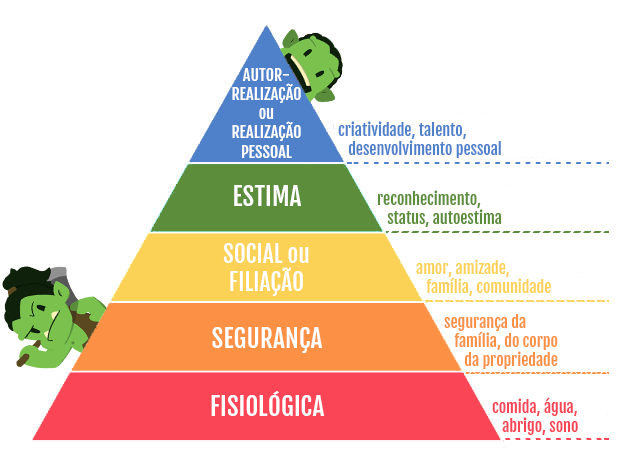
For Abraham Maslow, human needs are distributed hierarchically in the shape of a pyramid, and motivation is our impulse to satisfy them.
Maslow’s pyramid, as it is called, has physiological needs at its base, such as eating, followed by needs for safety, socialization, esteem, and finally self-actualization, with the top of the pyramid being responsible for our emotional goals.
Theory of Motivation by Achievement and/or Fear
According to David McClelland, there are three needs (or motives) responsible for human behavior:
- Achievement, which is satisfied through competition as a form of self-evaluation;
- Affiliation, which is satisfied through cordial and affectionate relationships;
- Power, which is satisfied through the influence exerted over others.
According to this theory, each person has a different level of need from others, but never a zero level of need. That is, there will always be traces of these needs, however small, especially “Achievement,” which is the first need learned during childhood.
Herzberg’s Two-Factor Theory
Herzberg’s motivation-hygiene theory, as it is called, states that there are two factors that affect an individual:
- Motivational / Intrinsic factors (that lead to satisfaction): These are factors under the control of individuals, as they are related to what they do and perform. They involve feelings of personal growth, professional recognition, and self-actualization;
- Hygiene / Extrinsic factors (that lead to dissatisfaction): These are factors managed and decided by the company, outside the control of people. The main factors are: salary, types of supervision, physical and environmental working conditions, internal regulations, etc.
The objective of this theory was to understand the factors that would cause dissatisfaction and those that would be responsible for satisfaction in the work environment.
In addition to these three theories that explain what motivation is, there are also others such as Self-Determination Theory and Motivation 3.0, which focus more on what can be done to achieve Intrinsic Motivation, which is one of the 8 types of motivation found in psychology, and which we will see next.
The 8 Types of Motivation
Intrinsic and Extrinsic Motivation
1. Intrinsic Motivation
Intrinsic Motivation, as its name indicates, comes from within ourselves and is related to our desires and internal impulses. You are driven to do something out of your own need and not because someone told you to do it, nor because you will gain something in return.
Several theories in psychology point out that people tend to stay more motivated when this motivation is intrinsic. An example of this is when you help a person in need for the sake of helping someone, without worrying about the reward you will receive for the action.
2. Extrinsic Motivation
Extrinsic Motivation, on the other hand, comes from an external factor, meaning it is induced by the environment. Whether through prizes or money, this motivation is marked by external stimuli that direct people’s actions.
A common example of this type of motivation is the points you earn on Waze for using the app and contributing to it.
Positive and Negative Motivation
Another way to classify motivations is according to the reward sought in the actions performed, that is, whether the goal is to gain something or to avoid some loss.
3. Positive Motivation
As the name indicates, positive motivation occurs when we act in exchange for some gain, such as when a person exercises – they do it to get stronger, thus it is a positive motivation.
4. Negative Motivation
Negative motivation, on the other hand, occurs when we act to avoid losing something. An example is people who play games constantly so they do not suffer any idleness penalty, this being a negative extrinsic motivation.
I do not know if you noticed, but these types of motivation are quite reminiscent of the black hat and white hat techniques that we discussed in the text Octalysis, the Gamification framework you need to know!
Personal and Social Motivation
Motivation can also be analyzed based on the consequences of actions: whether they are beneficial to the individual or to the collective.
5. Personal or Primary Motivation
This type of motivation is purely intrinsic and the reward aims to satisfy a need of the individual themselves, such as hunger, thirst, etc.
6. Social or Secondary Motivation
On the other hand, secondary motivation, despite being intrinsic, aims to achieve well-being through other people. Its rewards are difficult to measure, which is why it is considered more complex, but some examples are:
- The feeling of safety
- Respect
- Feeling of relevance
- Social recognition
Motivation in Sports and in Learning
Finally, short-term motivation can also be classified in relation to its focus, whether it is directed at a specific activity or at improving an aspect of our life.
7. Motivation in Sports or Ego-Centered
Ego-centered motivation is the impulse that makes a person maintain a high pace in an activity with a defined timeframe, like an athlete competing. This motivation can also appear in studies, when the person maintains a high level of focus for a period of time.
8. Motivation in Learning or Task-Centered
Motivation in learning is defined as the desires one has to improve and progress in a specific field of our life, whether professional or not. Task-centered motivation seeks long-term progress.
Indeed, motivation is not something simple, but I hope this text has clarified a little about this element that is so important to gamification and essential to our lives.
To learn more about gamification and its benefits, feel free to read our post “What is gamification and how it can change your life”, to browse the blog, follow us on social media (LinkedIn, Instagram, and Facebook), listen to our podcast, or get in touch with us!
This post was originally written in Portuguese and translated to English by Claude (Anthropic).
Originally published on the Orc’estra Gamificacao blog. All rights reserved.