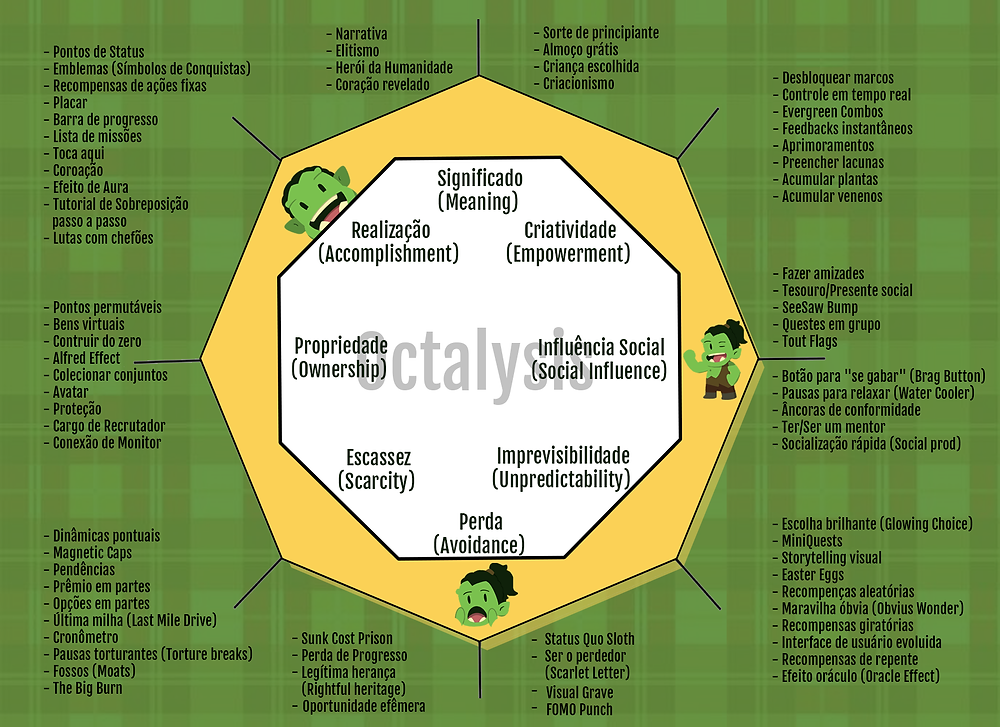
What is Octalysis?
Created by Yu-Kai Chou, Octalysis is a framework that assists in the development of gamification. At its core, it aims for Human-Focused Design to generate greater motivation and engagement from those who are the target of what is being developed.
If you still don’t know what gamification is, I recommend reading our article “What is gamification and how it can change your life” before continuing.
As the name suggests, Octalysis is composed of 8 Core Drives that motivate people to perform specific activities. Some provide inspiration and empowerment, while others manipulate and generate obsession, but all share the common factor of engagement and “hooking” people into a particular action.
But these Core Drives didn’t come out of nowhere. After more than 10 years of studies and research on gamification and games, Yu-Kai Chou realized that they were the common thread connecting all games. And nothing purer to serve as the foundation for gamification than games themselves.
The 8 Core Drives of Gamification
Not all Core Drives are present in every gamification, but every gamification has at least one of them. They create different motivations and have greater influence on different types of players, but all human actions are based on them, according to Yu-Kai Chou. (Player is the term used to refer to participants in a gamification)
Epic Meaning & Calling
This is the core drive related to the feeling of doing something greater or being “the chosen one” to do it. It can be seen in people who spend their time maintaining forums or contributing to Open Source projects – they are motivated by the belief that they are doing something for the benefit of the community.
This feeling also arises in games, when a person has “beginner’s luck” and, from that point on, believes they possess something special that other players don’t have.
Development & Accomplishment
Development & Accomplishment refers to the sense of progress, developing skills, and eventually overcoming challenges and achieving accomplishments. Challenge and achievement are very important, because a badge/trophy loses all its meaning without them.
This core drive is the easiest to work with, and that’s why most gamification systems using PBL (Points, Badges and Leaderboard) focus on it.
Empowerment of Creativity & Feedback
Empowerment of Creativity & Feedback occurs when a person enters a creative process, where they need to discover new things and try different combinations to reach a result.
The feedback from that result is also extremely important because, beyond expressing themselves, people also need to feel that they have achieved something, so they can continue working from there.
An example of this is Lego pieces, which can be assembled and disassembled multiple times to achieve different results.
Ownership & Possession
Ownership & Possession is the core drive related to the feeling of owning something. When a person believes they have something, they unconsciously feel the need to have more and better things.
This drive can be found in many examples: accumulating wealth, virtual goods, and even the time spent customizing a character or a virtual environment. The more effort you put into developing or achieving something, the more attached to it you become.
Who hasn’t wanted to keep a school project after spending hours and hours working on it..?
Social Influence & Relatedness
This core drive refers to all social elements that influence a person, including: mentorship, acceptance, social responsibilities, companionship, as well as competition and envy.
It occurs when a person sees something that triggers a feeling of nostalgia, or when a friend achieves something great and they feel motivated to do the same. It is also present in the feeling of socializing, getting closer to other people, places, and attending events.
Scarcity & Impatience
Scarcity & Impatience is linked to the act of waiting for something you can’t have yet. It is very common in mobile games, where you need to wait 5 to 10 minutes to build something or to earn another life and continue playing.
This core drive was used by Facebook in its early days: initially, it was a social network only for Harvard. Then it opened to other prestigious universities and eventually all universities. Finally, when it was opened to the public, many people were eager to use it because they previously couldn’t.
Unpredictability & Curiosity
Unpredictability & Curiosity is the core drive related to the desire to find out what will happen. When a person doesn’t know what’s going to happen, they keep thinking about it over and over.
This core drive is the primary factor behind gambling addiction, but it is also responsible for more everyday things like the desire to watch one more episode of a series or read one more chapter of a book.
Loss & Avoidance
Finally, Loss & Avoidance is based on the need to prevent something bad from happening. It can range from losing progress on a mission to losing everything that had been developed up to that point.
This drive can be seen in many games, such as in Minecraft’s Hardcore mode, where the player’s world is deleted if they die. In a lighter form, the game Legends of Runeterra has Ephemeral cards that disappear at the end of the player’s turn.
Left Brain vs Right Brain
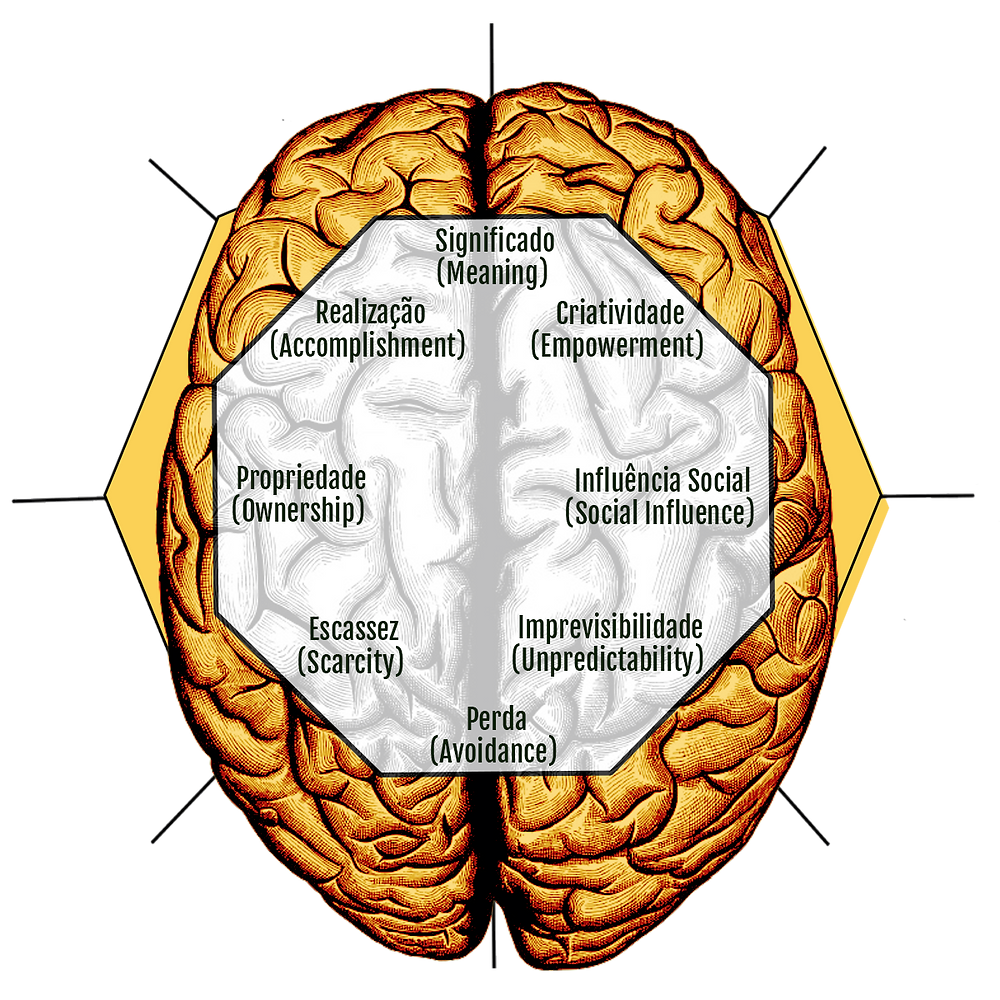
The 8 Core Drives of Octalysis can also be divided according to their position in the octagon.
The drives on the right side are called Right Brain Drives and are linked to creativity, forms of expression, and social aspects.
The drives on the left side are called Left Brain Drives and are related to logic, calculations, and ownership.
This division of sides also directly affects the types of motivation of the drives, with Right Brain Drives being intrinsic motivators, which motivate a person due to an internal feeling that was created, a desire to accomplish something, and Left Brain Drives being extrinsic motivators, which motivate a person due to an external incentive.
Differentiating the types of drive motivation is very important because several studies indicate that, despite being widely used, extrinsic motivations lose value when the external incentive is removed. In some cases, the engagement of the user who was under the influence of this incentive decreases.
To learn more about types of motivation, read our post “How gamification can make learning more effective?”, where we discuss this topic in greater depth.
White Hat & Black Hat Gamification
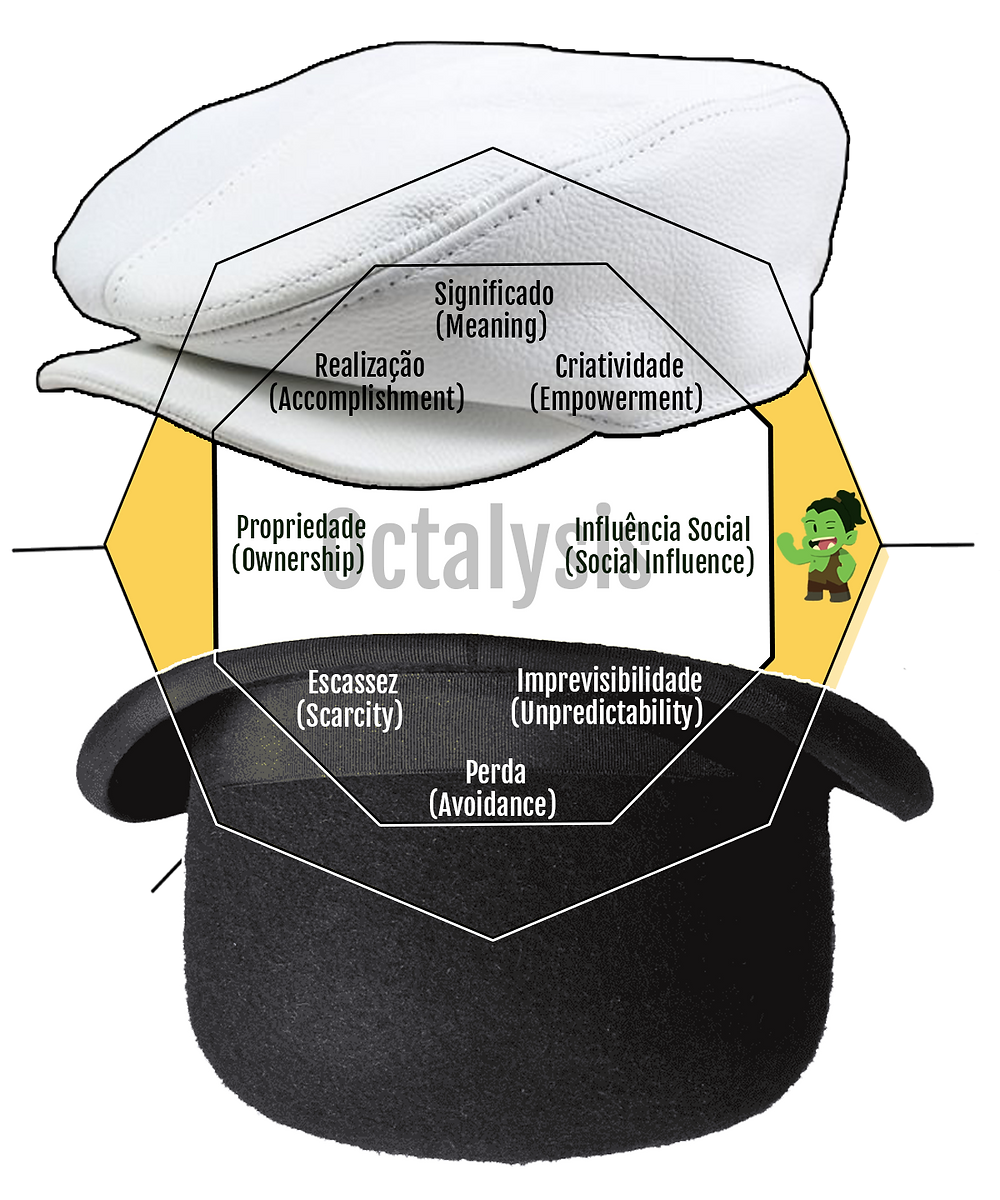
Another division of the Core Drives relates to White Hat and Black Hat gamification techniques.
The upper part of the octagon is considered positive motivators, while the lower part is considered negative motivators.
Expressing your creativity, receiving trophies, and feeling like you’re helping something greater are actions that bring joy to those who perform them, and if a person is motivated by such attitudes, they feel good.
On the other hand, if a person is always doing something out of fear of losing their progress, because they don’t know what will happen next, or because there are things they can’t acquire, they are still motivated, regardless of whether it brings an unpleasant feeling.
However, it is important to keep in mind that just because something brings an unpleasant feeling doesn’t mean it shouldn’t be used. A good gamification manages to balance Black and White Hat techniques to create a better experience for the player.
Gamification Examples with Octalysis
On his website, Yu-Kai Chou provides some examples of gamification evaluated using Octalysis. Below, I will reproduce the data provided and the comments made about the evaluations:
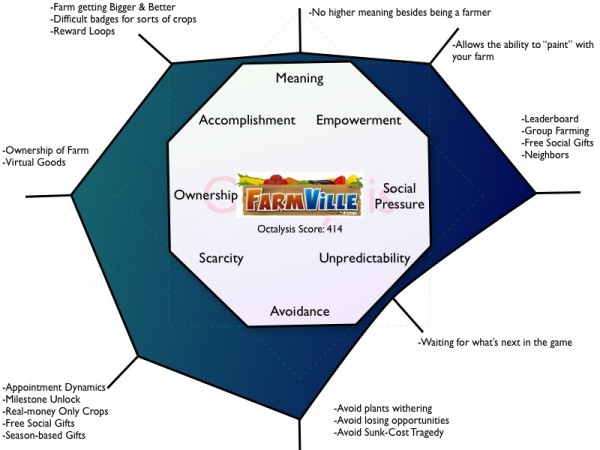
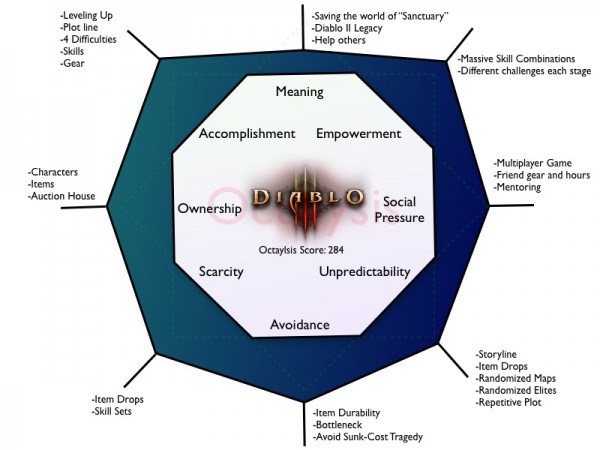
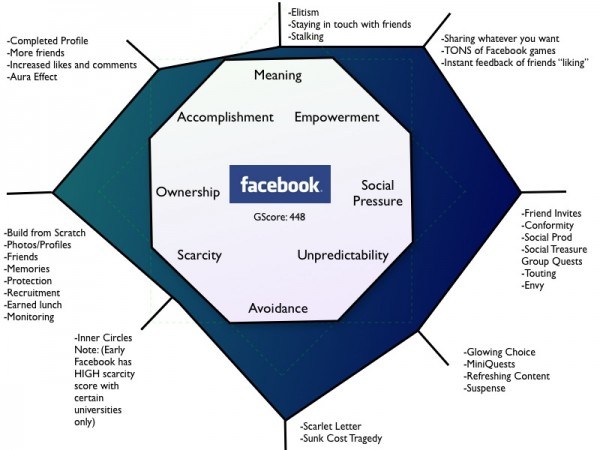
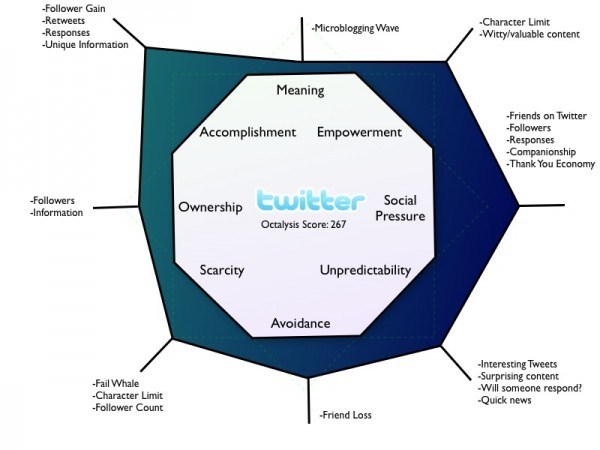
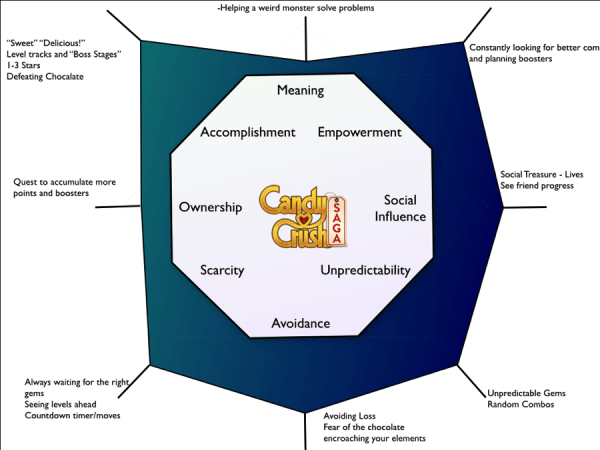
Farmville: 414 and, overall, Left Brain Black Hat;
Diablo III: 284, well balanced;
Facebook: 448 with a strong inclination toward Right Brain Drives (note that it has an opposite objective to Farmville, when compared);
Twitter: 267, well balanced, but with inclinations toward Right Brain;
Candy Crush: Balanced.
As can be seen in this article, Octalysis is a very complete and complex framework, and with it, it is possible to create diverse gamification systems. If you would like to see some practical examples, check out our portfolio!
But, believe it or not, everything I mentioned here only refers to level 1 of this tool…
To learn more about gamification and its benefits, feel free to browse the blog, follow us on social media (LinkedIn, Instagram, and Facebook), listen to our podcast, or get in touch with us!
This post was originally written in Portuguese and translated to English by Claude (Anthropic).
Originally published on the Orc’estra Gamificacao blog. All rights reserved.