Motivation 3.0 is a new concept about the way people motivate themselves intrinsically, and in this post, we are going to talk about how motivation happens, according to Daniel Pink’s perspective.
I imagine you have already heard about motivation, but if you haven’t, we have the article “What type of motivation drives you?” which is perfect to introduce you to the subject.
How do you think motivation happens?
Would it be by giving gifts, rewards, or prizes to people, or by giving them the freedom to choose how to fulfill their role in society?
Well, we can say that the first option is widely used in many professional settings, but according to Daniel Pink, in his book Drive: The Surprising Truth About What Motivates Us, this notion is wrong.
Motivation is historically divided into 3 parts:
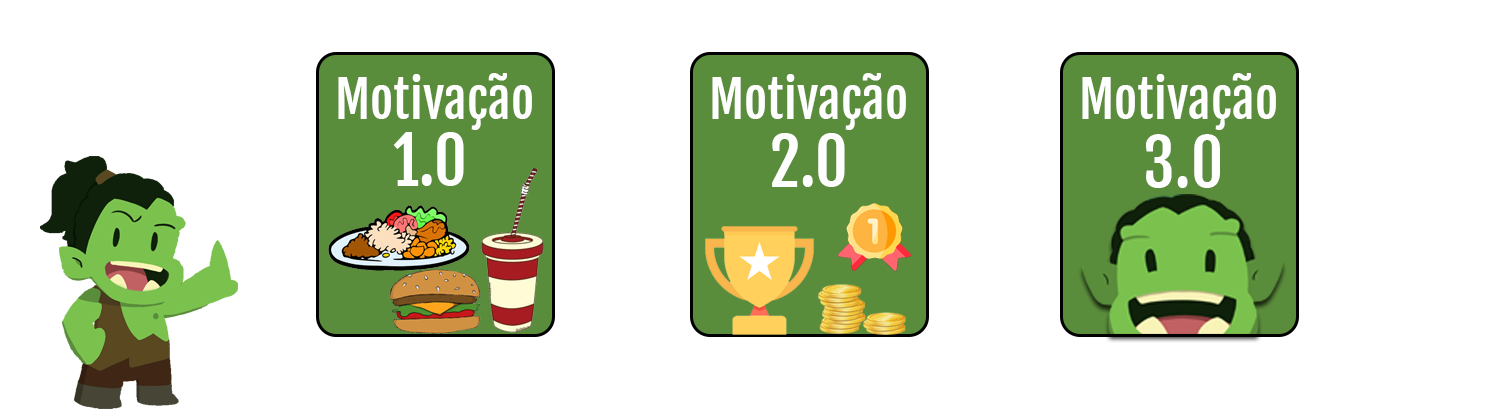
Motivation 1.0: This is the most basic cycle, where motivation arises from basic needs, such as hunger, thirst, shelter, etc.
Motivation 2.0: This intermediate-level cycle, already mentioned earlier, is where people are rewarded for something they have done, and this motivates them in some way. We say that motivation occurs extrinsically.
Motivation 3.0: This is the cycle that truly motivates people. And this cycle is supported by 3 elements.
- Autonomy: the human desire for control over one’s own life.
- Mastery: the human need to become good at something.
- Purpose: the need to feel that you are part of something bigger and more meaningful.
But what is the problem with extrinsic motivation?
Extrinsic motivation is something external and comes very little from the individual themselves. When we are children, we carry out our activities in a more lively way, because we are motivated through stories and tales that make us think the world we live in is a fantasy world. In this way, we feel naturally motivated.
Over time, we then experience the shift of this paradigm to being motivated by a system of rewards and punishments, where we are influenced to take actions through extrinsic motivation.
The problem with this is that the focus shifts from the problem that needs to be solved to the reward that will be received.
For example, when developing a project, many people don’t think about the purpose of how it can be great for everyone, but rather about how they will be rewarded upon finishing it. The result is low-quality work, because the focus was on finishing it as quickly as possible.
This makes it harder to relate to other people who don’t agree with this work method, which can end up being somewhat unethical when performing a task in a half-hearted way. In addition to posing risks to the work and demotivating other people.
Can extrinsic motivation be useful?
Of course… Extrinsic motivation can be useful for very repetitive and tiring tasks that require little creative effort. However, it is always good to make it clear to those involved in the task that rewards should not be the priority, to prevent the work from being done in a desperate and ineffective way.
The rewards for these tasks don’t necessarily have to be material things, but can be intangible prizes, such as positive feedback, recognition for everyone.
Extrinsic motivation in a less material form helps the person internalize the cause of that motivation, which gradually becomes more and more intrinsic, according to Self-Determination Theory.
But after all, how do you develop intrinsic motivation?
As we have already said, intrinsic motivation is based on 3 main pillars: autonomy, mastery, and purpose, and they are very important for the development of our personal motivation.
Autonomy

It is important to give people the freedom to work, to make them feel comfortable with the work environment.
They need to have control over the time they will dedicate to that task, and how they will go about completing it.
In a company, for example, it is important that employees have the freedom to better organize their time, so they can choose to work at times when they are most motivated, thus producing higher-quality work.
Mastery

Daniel Pink says that mastery has 3 important foundations:
- First, mastery is a mindset, meaning people have to feel that they can improve and believe in their own capacity for growth;
- Second, mastery is a pain, because it only comes through a lot of effort, hard work, and extensive practice;
- Third, mastery is never enough, it is impossible to fully achieve it, meaning we can always evolve and do better work.
Let’s start from these 3 foundations, so we can assign tasks to the people around us and in our professional environment. Always with a gradual increase in difficulty, so that the person feels they are improving compared to the previous activity.
Challenges must exist, but balanced with competence, so that they grow proportionally, as is also shown in Flow Theory. This allows for the development of a skill and the growth of the person who seeks mastery.
Purpose

Just as we talked about mastery, purpose is also supported by 3 main foundations, which are:
- Doing something important.
- Doing what is important well.
- Doing it in service of a greater cause.
Pink states that companies could care less about profit and more about purpose, which would bring employees the feeling of importance for what they are doing.
Obviously, profit is the fuel that keeps the company running, but we can consider that the profit we receive at the company is so that we can achieve our purpose, which could be Professional Development, for example. Giving meaning to everything that is being worked on and developed.
In this way, a virtuous cycle is created where we work for a purpose and that work generates profit, which shortens our path to the company’s ultimate purpose as a whole.
To learn more about gamification and its benefits, feel free to read our post “What is gamification and how it can change your life”, to browse the blog, follow us on social media (LinkedIn, Instagram, and Facebook), listen to our podcast, or get in touch with us!
This post was originally written in Portuguese and translated to English by Claude (Anthropic).
Originally published on the Orc’estra Gamificacao blog. All rights reserved.