The Hero’s Journey… A little-known concept, but one that is present in many moments of our daily lives and especially in our childhood.
However, let’s start from the beginning – what is the Hero’s Journey and where did this idea come from?
The Monomyth
Before talking about the Hero’s Journey, it is better to start with another concept, the Monomyth, which refers to a cyclical journey found in myths.
This concept was developed by the anthropologist Joseph Campbell, who used the term in his book “The Hero with a Thousand Faces”, after extensive studies of the works of James Joyce.
Divided into three main sections, the monomyth consists of:
- Departure: The moment when the hero sets out on their adventure;
- Initiation: The various adventures in which the hero becomes involved;
- Return: Defined by the moment when the hero returns home with the knowledge and lessons acquired on their journey;
And these three patterns can be seen in many stories, from classics of Greek mythology, such as the Odyssey, to Hollywood films, such as the Star Wars trilogy.
The Origin of the Journey
And where does the Hero’s Journey fit into all of this? It is exactly in what has been discussed so far! The monomyth can be seen as the predecessor of the Hero’s Journey, a “rough diamond” discovered by Campbell and polished by Christopher Vogler, a Hollywood screenwriter and film industry executive.
Vogler, with the intention of creating a memo for Disney studios, studied Campbell’s theories and wrote the book “The Writer’s Journey: Mythic Structure For Writers”, which synthesized the journey described in the monomyth and served as the foundation for the development of several films, from The Little Mermaid to Mulan.
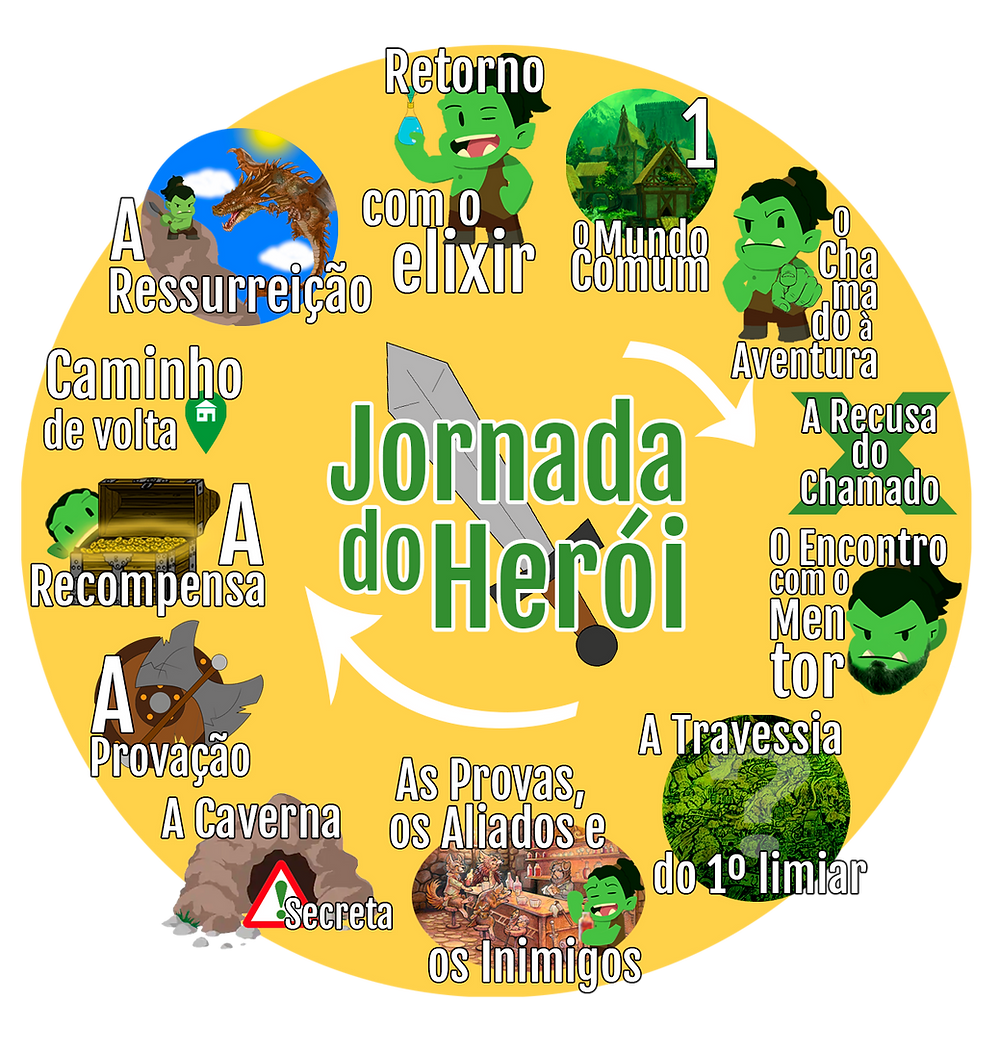
And in this book was the long-awaited Hero’s Journey, a set of twelve stages that form a beautiful story! Briefly, the stages can be defined as follows:
- The Ordinary World: referring to the initial state of the story (status quo), the world before the adventure, who the hero is, how they live, and what they are like. It is the moment that gives the audience time to identify with the hero and their characteristics;
- The Call to Adventure: the initial conflict, the external factor that pulls the hero out of their comfort zone and leads them into the adventure – not necessarily something bad or dramatic, but rather a challenge;
- Refusal of the Call: this would be the fear one feels in the face of something new, something common in people, and this stage shows that the hero also feels this, making them an ordinary person to the audience, which helps people identify with them;
- Meeting the Mentor: the moment when the hero meets someone who helps them improve, “grow stronger,” and provides the necessary encouragement for them to overcome their fear, their hesitations, and face the challenge of the Call to Adventure;
- Crossing the First Threshold: the first step on their new journey, not necessarily a physical place, but a journey into something previously unknown to the hero;
- Tests, Allies, and Enemies: the journey has begun and now the hero finds themselves in a new world, and during their adventure they face various challenges, make allies, and encounter enemies – it is the period in which they hone their skills;
- Approach to the Inmost Cave: the moment of doubts, when the hero begins to question themselves and everything they are doing. They see that a great challenge is coming and it frightens them, causing them to pull back a little;
- The Ordeal: the greatest crisis the hero has faced, the final challenge that requires the union of all their knowledge and all their strength. Overcoming death, resolving an internal conflict, or even fighting a very powerful villain;
- The Reward: the prize after the ordeal, which may be something physical or not, but, metaphorically, it is the transformation the hero undergoes by overcoming so many challenges and surpassing themselves time and again;
- The Road Back: the journey is coming to an end and the hero is returning home… There are no longer so many challenges, but rather a great moment of reflection on everything that happened, everything they suffered, and everything they overcame;
- The Resurrection: the highest point of the story, where a great challenge appears when everyone least expected it, and this time the hero must win, because defeat would cause extreme damage to everything they know;
- Return with the Elixir: and the journey comes to an end, the hero returns home with their rewards and is recognized for everything they did, they resolve the initial challenge and wrap up everything that made them set out on their journey.
The Hero’s Journey in Gamification
But after reading all of this, you must be thinking “The Hero’s Journey is cool, but from what I’ve read, it’s for making movies… Where does gamification come in?”, well then, the idea of the Hero’s Journey can be applied to gamification in a very useful way, but, as I said, the idea of the journey and not the journey in its entirety.
But before you continue reading, it is important to know what gamification is, so if you don’t know, take a look at our text “What is gamification and how it can change your life (just as it changed mine)?”, and once you’re done, continue reading the next paragraph!
Some stages, such as the Call to Adventure and Crossing the First Threshold, are extremely important at the beginning of a gamified system, as they serve to immerse the user in this “new universe” that gamification can bring. Immersion is very important for captivating users and influences the success or failure of a project.
Have you ever stopped to think about why one game keeps you hooked for hours while others don’t? One of the factors that causes this is immersion – you feel like you are inside that game, that world, and you spend hours there without realizing it, and the Hero’s Journey fits right in, in introducing the user to a new universe and keeping them in that environment.
The stages The Ordinary World, The Ordeal, and Return with the Elixir also serve as a basis for creating the Epic Meaning of gamification, which is an essential tool in White Hat techniques and greatly strengthens the user’s immersion in the entire story, as it gives additional meaning to everything they are experiencing.
The Ordeal also plays a role in another important point, together with Tests, Allies, and Enemies, which are the activities carried out during the gamified experience. The initial tasks should be simpler, like the hero’s tests, but at a certain point in the story they should become difficult, like the final ordeal, which creates greater engagement among the players, according to the Flow Theory.
The Hero’s Journey in Everyday Life

And remember when I said the journey was present in many moments of everyday life? You probably already have some ideas, besides the films already mentioned, but now I will give an example that I, personally, like to use to explain this concept.
The film Hercules, released by Disney in 1997, depicts the story of the demigod Hercules, a common story from Greek mythology. What is interesting about the film, when analyzed through the lens of the Hero’s Journey, is how it clearly demonstrates each stage of the process.
They can be identified in the following scenes:
- The beginning of the film in the village;
- His parents telling Hercules that he was the son of Zeus;
- The doubt about what to do and about his potential after meeting Zeus on Olympus;
- Training with “Phil”;
- The journey to the city of Thebes;
- The “rescue” of the damsel in distress;
- The failures and lack of recognition as a hero in his first heroic acts, along with the questions this raises;
- The twelve tasks, with the Hydra being a greater challenge;
- The recognition and fame;
- The hero established in Thebes and the time of peace in the city;
- Hades releases the Titans and Hercules has to defeat them;
- The world is saved and Hercules returns to Thebes.
There are other points in the story that fit into the stages (so much so that I deleted and rewrote the paragraph above several times), but all of them serve to show how the Hero’s Journey can be easily found in many films.
TV series, games, and anime also follow these stages – The 100, The Legend of Zelda, Hunter x Hunter… Among many others. Practically everything can fit into the stages of the journey, not necessarily fulfilling all of them, but following most, and the most interesting thing about this is that even your life can be seen in the stages of the journey!
The first day at school? Sounds a lot like The Call to Adventure; First failure? I think that would be Approach to the Inmost Cave… The all-nighters spent studying for a job interview and, after all the suffering, getting hired?! Without a doubt, that would be The Ordeal and The Reward!
It is not hard to find moments in life that resemble the journey, and daily things even became more interesting after I pointed this out, right?! That is why films, games, and cartoons captivate us so much, because we see inspiration in them and that gives us motivation to do things. In gamification it works the same way and, through the Hero’s Journey, it is possible to engage people!
Texto originalmente publicado no blog da Orc’estra Gamificacao. Todos os direitos reservados.
This post was originally written in Portuguese and translated to English by Claude (Anthropic).
Originally published on the Orc’estra Gamificacao blog. All rights reserved.