There are several types of motivation, but among them, extrinsic and intrinsic motivation deserve special attention. In Self-Determination Theory (SDT), researchers Ryan and Deci discuss a form of “evolution” of motivation, which goes from amotivation to intrinsic motivation, passing through 4 stages of extrinsic motivation, and that is what we will discuss in this text.
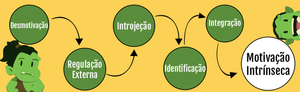
But before we get into Cognitive Evaluation Theory, we need to discuss Basic Needs Theory, which is one of the foundations of self-determination.
Basic Needs Theory
According to Ryan and Deci, human beings are naturally inclined toward development, with an internal desire for growth in terms of knowledge and skills. This happens because of the intrinsic needs for autonomy, personal competence, and relatedness (or social bonding).
The need for autonomy can be defined as the ability to act and make choices that align with each person’s individual values, with a high level of reflection and awareness. A “sense of self,” which relates to the notion of the individual person, unique and distinct from others.
The need for personal competence is related to adapting to the environment and refers to the individual’s ability to learn, as well as cognitive development. This need encompasses everything from the pursuit of survival, the execution of practical activities, to competence in effective social participation.
The need for social bonding, on the other hand, gives rise to the search for relationships with other people, groups, or communities, in pursuit of loving and being loved. It also gives rise to concern, responsibility, sensitivity, and support in affective relationships.
Intrinsic motivation arises from actions that are intended to fulfill basic needs, whose ultimate goal is the integration of the person into the social environment, but in a manner consistent with the cultural values in which they are embedded.
Cognitive Evaluation Theory
Cognitive Evaluation Theory is, like Basic Needs Theory, a part of SDT, and in it the basic motivations – intrinsic and extrinsic – and individual differences in motivations are studied.
From it, it is possible to highlight the various forms of extrinsic motivation and how it evolves through the internalization of the factors that created it, forming a continuous path that goes from the lack of motivation, through extrinsic motivation, until reaching intrinsic motivation.
This entire path can be visualized in the Taxonomy of Human Motivation, presented below:
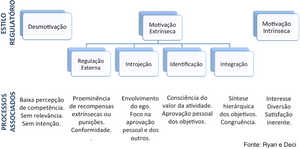
Amotivation
Amotivation occurs when there is a lack of intention and willingness to act. In this state, the action is performed only occasionally to meet external demands. It can occur when the person believes that the activity they must perform has no value, or they believe they lack the competence to carry it out.
You have probably seen a child give up on a game after dying several times in a row, right? This happens because they develop the feeling that they lack the competence to play that game and that they will never achieve the expected result, which is to pass the level.
As explained in Flow Theory, anything that is too difficult or too easy creates a situation of amotivation.
External Regulation
External regulation represents a less autonomous state of extrinsic motivation, where people are motivated by entirely external factors, such as rewards and punishments.
An example of this is people who do not enjoy their job but work overtime for the financial bonus.
Introjected Regulation
On the other hand, if the person begins to perform activities that are not in accordance with their values, but to please someone or even to avoid further annoyances, this motivation becomes introjected.
The activities are performed with a feeling of pressure, anxiety, to avoid guilt, to satisfy the ego or pride, such as when a student decides to take a course to please their parents.
Identification
Motivation regulated by identification occurs when there has been a prior evaluation, by the person, of the conditions of the context and they then decided that the action was momentarily convenient.
It is easily seen in people who go on diets or exercise for a period of time, to avoid health problems, and then stop.
Integrated Regulation
Being the most autonomous form of extrinsic motivation, integrated regulation occurs when the person becomes accustomed to performing an action and that action is in accordance with their values. However, the action itself has no meaning for the person, but rather what they will achieve through it.
Intrinsic Motivation
Finally, we have intrinsic motivation. This happens when the person acts according to their internal motives, based on intrinsic needs (autonomy, competence, and social bonding).
Actions that have meaning for the person and that, despite achieving a final goal, performing the action itself is already satisfying and generates a sense of well-being.
Although intrinsic motivation is clearly important, most activities performed by people are extrinsically motivating. Fortunately, through the internalization of the factors that lead us to perform an action, it is possible to transform it into a self-determined action and, thus, reach intrinsically regulated motivation.
To learn more about gamification and its benefits, feel free to read our post “What is gamification and how it can change your life,” to browse the blog, follow us on social media (LinkedIn, Instagram, and Facebook), listen to our podcast, or get in touch with us!
This post was originally written in Portuguese and translated to English by Claude (Anthropic).
Originally published on the Orc’estra Gamificacao blog. All rights reserved.